

The madness behind the belief: Superstition expert explains fan rituals
LEXINGTON, Ky. (March 13, 2026) — It’s the familiar March Madness frenzy: bracket predictions, buzzer-beater highlights and, of course, the quirks of fandom.
Basketball fans have long found ways to feel like they can influence the outcome of a game — even from the couch.
We embrace traditions that range from lucky attire to sitting in the same spot.
Bracket bias: How identity shapes our picks
LEXINGTON, Ky. (March 9, 2026) — Every March, millions of Americans fill out brackets convinced they’re making smart, data-driven picks.
But when the upsets roll in — and our favorite teams advance further on our sheets than the stats suggest they should — it raises a bigger question: are we choosing with our heads, or with our identities?
One Day for UK

One Day for UK is the University of Kentucky’s 24-hour online giving day. On April 23, 2026, the Big Blue Nation will come together to support the colleges, programs and causes that we love at UK. Join a tradition of generosity that Fuels the Mission and Drives Success for every Wildcat. Visit www.onedayforuk.com to follow our progress and make your gift.
You help students cross the Finish Line
Earning a college degree, walking across the stage at Rupp Arena, is one of the proudest moments in students' academic careers. But for some students, financial barriers can delay that achievement. An unexpected bill can keep a student from their moment, even with just a few more classes to take. The Finish Line Fund provides immediate support to students in the homestretch of graduation.
No student should have to put their dream on pause because of a financial hurdle. Your gift on April 23 ensures it does not.

"The scholarship helped me complete my fourth year, mentally and socially. It's helped me with schooling, housing, food, transportation and even small things, like being able to like go out and enjoy time with friends. It's more than just financial help."
Jermaine Harris, Finish Line Fund
Give students the boost they need to complete their degrees. Give to the Finish Line Fund on April 23.
Every part counts! We need your help spreading the word about One Day for UK. Follow us on social media and share our posts about One Day for UK.
Get involved
Make a difference in a department or program you care about. Click 'give' and use the dropdown to find a fund you would like to support.
Give to a department or program
Need help? See a tutorial on how to give to a department or program.
Date:
-
Location:
Virtual
Statistics Seminar
Title: Reconciling Least Squares and Robustness in the Two-Way Layout Fixed Effects Experimental Design with an Example from R. A. Fisher’s book "The Design of Experiments."
Abstract: In the last 18 years, the speaker has written two international books in the Wiley Series in Probability and Statistics in essentially diametrically opposing areas of statistical practice. The first book was published in 2008 and is titled "Linear Models the Theory and Application of Analysis of Variance." That book begins with a historical development of least squares analysis and normal likelihood theory analysis of the linear model through the auspices of experimental design and analysis of variance, basically as was developed by R.A. Fisher and his contemporaries. The second book, published 10 years later, describes the functional approach to robustness, particularly through the story of M-estimation. The title of the book is "Robustness Theory and Application." This book details a modern theory of statistical inference developed since the 1960s. So, what is the “right” way to approach statistics when analyzing data?
Some insight is offered by appealing to a classical analysis of a linear model representing the data used to form a two-way layout that is proffered in the book “The Design of Experiment” by R.A. Fisher for the purposes of illustrating the analysis of variance for a Randomized Complete Block Design. It is a summarized data set of Immer et al. of yields of five barley varieties for 12 different years, by location combinations. The data reveal outliers and heteroscedasticity.
For these data, we review the appropriate least squares and robust approaches to the analysis.
The history of the robust approach is explained by recounting the development of Huber's M-estimators, the influence function of Hampel that is drivable for any estimator, and why the Fréchet differentiability of M-estimators as described by the speaker in the 1980s established under certain conditions for M-estimators guaranties the robustness of an M-estimator. The early example of a Fréchet differentiable M-estimators afforded by the Tukey Bi-square Functional M-estimator are supported in robust computer packages and are applicable to the linear model representing the two-way layout. Different choices of constraints under parameter redundancies used in different models require one to first represent the analyzes using the same model, before making comparisons. The approach is similar to that of H. Scheffé.
Digressions are made to discuss non-smooth versus smooth M-estimation and to emphasize that the least squares diagnostic approach of transformation is also fraught with danger. Otherwise, we show that both least squares, properly done, and robust inferences essentially agree for these data. This observation reinforces the results resolving what potentially could have been a schizophrenic like situation.
Date:
-
Location:
MDS 223
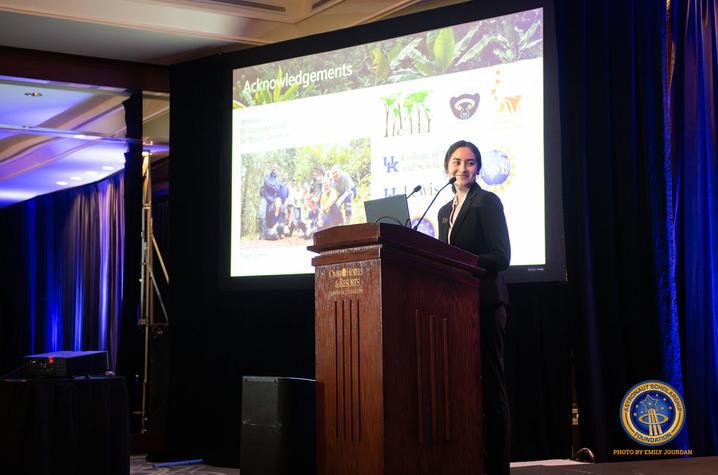
Arts and Sciences undergrads to present at national research conference
LEXINGTON, Ky. (March 5, 2026) — Forty-eight University of Kentucky students will present their research at the National Conference on Undergraduate Research on April 13-15 in Richmond, Virginia.
The conference is one of the largest events in the United States for undergraduate students to share their academic work with peers, faculty and professionals.
Hall of Fame 2026
The College of Arts and Sciences is honored to induct the following exceptional alumni and emeriti faculty into the 2026 Alumni Hall of Fame. These are individuals who exemplify the foundational importance of an arts and sciences education and who have made significant contributions to their professions, their communities, and the University of Kentucky.