Chemistry Department Seminar
----------
Please note the updated time and location of this event.
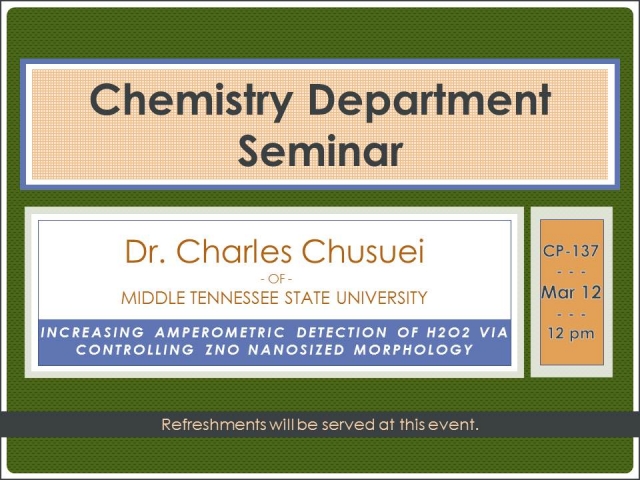
Dr. Charles Chusuei of Middle Tennessee State University will be presenting a seminar titled:
Faculty Host: Dr. David Atwood

----------
Please note the updated time and location of this event.
Dr. Charles Chusuei of Middle Tennessee State University will be presenting a seminar titled:
Faculty Host: Dr. David Atwood

----------
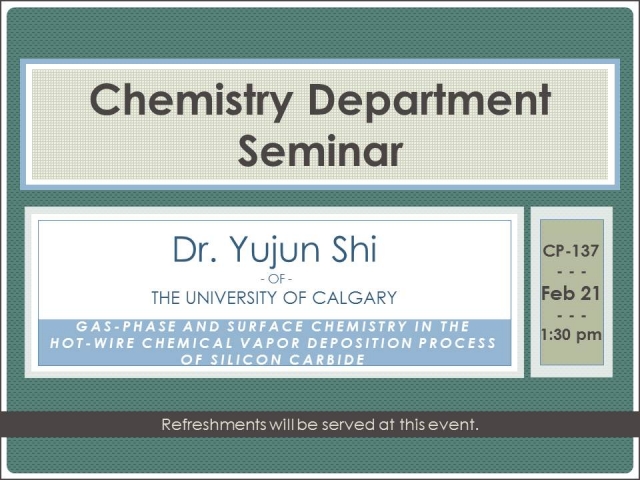
Dr. Yujun Shi of the University of Calgary will be presenting a seminar titled:
Gas-phase and Surface Chemistry in the Hot-wire Chemical Vapor Deposition Process of Silicon Carbide
Faculty Host: Dr. Dennis Clouthier

----------
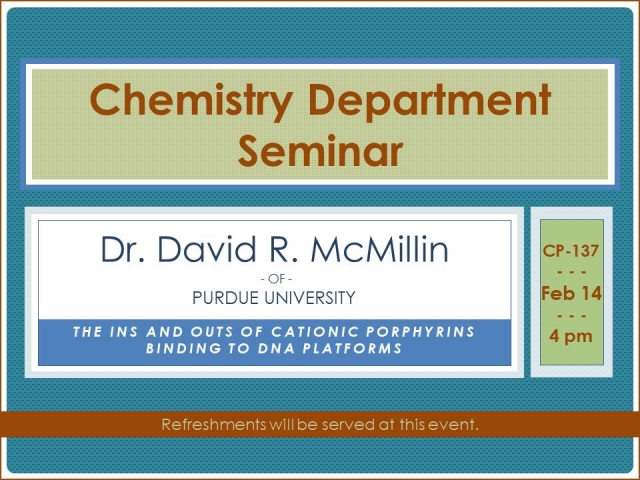
Dr. David R. McMillan of Purdue University will be presenting a seminar titled:
The Ins and Outs of Cationic Porphyrins Binding to DNA Platforms
Abstract: The well known cationic porphyrin, meso-tetrakis(N-methylpyridinium-4-yl)porphyrin (H2T4), binds effectively to DNA. However, literature studies reveal the binding motif varies with the base make up of double-stranded hosts. Characterizing the binding interactions is of interest from the point of view of fundamental supramolecular chemistry as well as with regard to potential therapeutic applications. Meso-N-methylpyridinium-4-yl substituents of H2T4 play a critical role in shaping the binding because they affect the steric properties, overall charge, and water solubility of the ligand. In search of additional spectroscopic handles and more consistent binding, the McMillin group has used absorbance, emission, and circular dichroic methods to characterize the binding interactions of copper(II) derivatives of sterically less demanding, dicationic systems like 5,15-di(N-methylpyridinium-4-yl)porphyrin (H2tD4), as well as the H2T4 control. It turns out the substituents affect not only the mode of binding but the reactivity as well. When copper(II) is present, luminescence is especially useful for establishing binding motifs to a variety of single- and multi-stranded DNA hosts. Binding patterns emerge, and ligand-ligand interactions occur, especially at high drug load. The Pd(T4) and Pd(tD4) analogues are more useful for sensitizing singlet oxygen, because the triplet lifetimes extend to hundreds of microseconds in deoxygenated solution. Surprisingly, the efficiency of singlet oxygen production is similar for intercalated and externally bound forms of the bulky Pd(T4) system. However, energy-transfer quenching is a strikingly more efficient process with the sterically friendly analogue, Pd(tD4), which exclusively binds by intercalation. Better orbital overlap in the precursor complex may account for the enhanced energy-transfer rate.
Faculty Host: Dr. Edith Glazer

The visiting South Korean teachers currently studying at UK are part of a long line of successful educational partnerships for the University’s Center for English as a Second Language (CESL) program. The experience for these teachers, however, is a bit different: they are the first to receive graduate credit by participating UK’s newly-formed master’s program in Teaching English as a Second Language (TESL).
What kinds of life characterized the Earth during the Precambrian?
Beginning January 27th, the Department of Chemistry will begin a free, online course titled "Advance Chemistry" for prospective and current students.
"Las Voces de los Apalaches" will be an evening to help celebrate the "Year of Mexico!" First will be a dramatic presentation in Worsham Theater, beginning at 7 p.m. To follow the dramatic presentation is the band Apalatin.