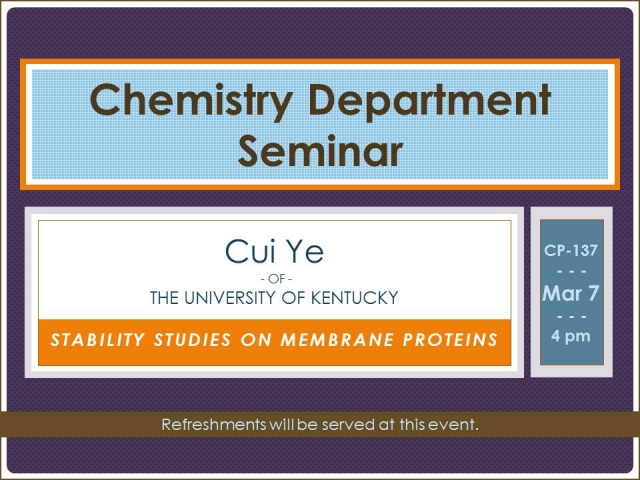
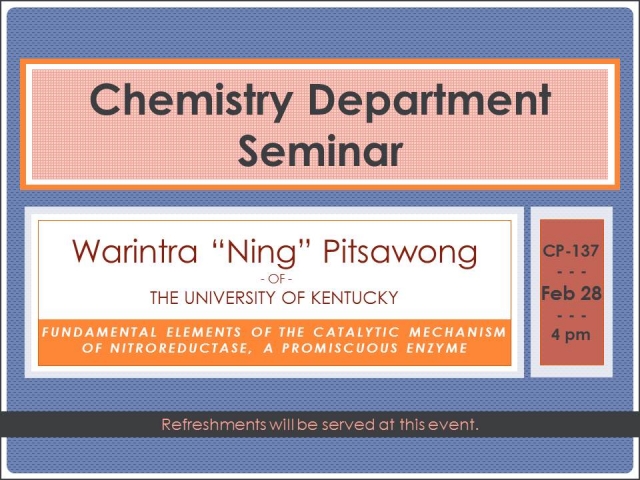
----------
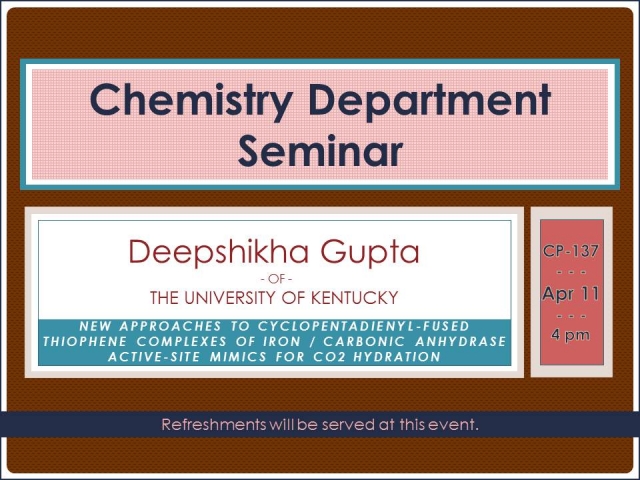
Deepshikha Gupta of the UK Chemistry Department will be presenting a seminar titled:
1) New Approaches to Cyclopentadienyl-Fused Thiophene Complexes of Iron
2) Carbonic Anhydrase Active-Site Mimics for CO2 Hydration
Topic 1 - New Approaches to Cyclopentadienyl-Fused Thiophene Complexes of Iron
Abstract: One fundamental property that normally distinguishes polymers from metals is their electrical conductivity. The value of electrical conductivity for metals is very high. During the last two decades, researchers, through the simple modification of ordinary organic conjugated polymers, have succeeded in preparing electrically conducting polymers. These materials combine the electrical properties of metals with the advantages of polymers, such as lighter weight, greater workability, resistance to corrosion and chemical attack and lower cost. These properties make them extremely attractive for many applications, including light-emitting diodes (LEDs), chemical and biological sensors, microelectronic devices, and advanced textiles. Our group’s long-term interest is in the electronic properties of organometallic analogues of the low-band-gap polymer poly(benzo[3,4-c]thiophene) (polyisothianaphthene) that incorporates η5-cyclopenta[c]thienyl monomers such as ferroceno[c]thiophene. In this talk, synthetic routes to 1,4-dihydro-2,3-ferrocenodithiin, an important precursor of ferroceno[c]thiophene will be discussed.
Topic 2 - Carbonic Anhydrase Active-Site Mimics for CO2 Hydration
Abstract: The enhancement of CO2 absorption using a catalyst is a critical component to reduce the capital cost for CO2 capture. Our research focuses on exploring effective ways to minimize CO2 emission by developing a catalyst to enhance the rate of CO2 hydration. We focus our efforts on complexes of zinc(II) and similar metal ions with ligands such as 1,4,7,10-tetraazacyclododecane (cyclen), 5,5,7,12,12,14-hexamethyl-1,4,8,11-tetraazacyclotetradecane (teta and tetb), tris(benzimidazolylmethyl)amine (BIMA) and anionic tris(pyrazolylborate)s that mimic the enzyme, carbonic anhydrase. Several of these complexes reported so far contain the hazardous perchlorate ion. We are developing Cu, Co and Zn complexes with benign, non-coordinating counterions that avoid the potentially explosive perchlorate salts. [Zn(cyclen)H2O][SiF6] as well as a number of other catalysts have been synthesized and tested for their post-combustion CO2 capture enhancement capabilities in aqueous solvent mixtures. [Zn(cyclen)(H2O)][SiF6]•2H2O, which has an unreactive counteranion, has confirmed catalytic activity.
Faculty Advisor: Dr. John Selegue

 I was born in Louisville second oldest of four. During high school I thought music was going to be my life until college. I attended UofL but soon transferred to UK where I found what I enjoyed. I received a Bachelor’s Degree of Hospitality and Management Tourism. Working as a front desk for Holiday Inn Express in Nicholasville wasn’t my ideal job. Friends encouraged me to apply at UK. A week later I got a phone call asking me to come in the next day to start work. I began working with the A&S IBU for Chemistry, Physics, and Anthropology through STEPS. I worked for about two months as a STEPS employee before I became a permanent full-time employee in January.