
Stars With Accents 2011 - Part 2 of 2
Readings by Jane Gentry Vance, Honoree Fanonne Jeffers, and Jan Isenhour, introduced by Katerina Stoykova-Klemer
Readings by Jane Gentry Vance, Honoree Fanonne Jeffers, and Jan Isenhour, introduced by Katerina Stoykova-Klemer
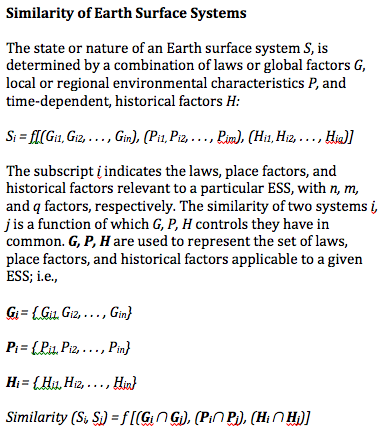
I've thought, written, and talked a lot about the need to incorporate geographical and historical contingency--that is, idiosyncratic characteristics of place and history--in geosciences, in addition to (not instead of!) general or universal laws. I've also emphasized the fact that places and environmental systems have elements of uniqueness. This leads to the issue of how to measure or assess place similarity (or the similarity of different, e.g., landscapes, ecosystems, plant communities, soils, etc.). This is a way of thinking about this problem, dressed up with some formal mathematical symbolism. Though I'm personally pretty informal, I'm a big believer in formal statements in science, as it makes arguments at least partly independent of linguistic skills (or lack thereof).
The Department of Hispanic Studies is excited to welcome Associate Professor Monica Diaz to its faculty!
This podcast is part of a series highlighting the new faculty members who joined the College of Arts and Sciences in the fall 2014 semester.
This podcast was produced by Casey Hibbard.
This event brings faculty and staff into the halls and allows students to ask any questions they may have. This year we have academic advisors, campus activities staff, and faculty participating on our panel.
Reality vs. Reality TV – This session looks closely at how pop culture influences our perception of relationships – both healthy and unhealthy. Participants examine the relationships of various TV couples (including Disney, MTV, Bravo, and other celebrity couples) and discuss the impact edited/scripted relationships have on how we see relationships that play out in our daily non-edited/non-scripted lives.
This will count as a Wired event.
EXPLORE YOUR OPPORTUNITIES: Featuring the Colleges of Agriculture, Food, & Environment, Arts & Sciences,Business & Economics, Communication, Design, Education, Engineering, Fine Arts, Health Sciences, Nursing, Pharmacy, Public Health, & Social Work.
ENHANCE YOUR EXPERIENCE: Featuring the Academy of Undergraduate Excellence, the National Student Exchange, Education Abroad, the Stuckert Career Center, & Undergraduate Studies.
This will count as a Wired event!
Trick or treat! The Department of Chemistry is offering local children a sugar-coated chemistry lesson a full week before Halloween.
The Department of Chemistry is excited to welcome Assistant Professor Peter Kekenes-Huskey to its faculty!
This podcast is part of a series highlighting the new faculty members who joined the College of Arts and Sciences in the fall 2014 semester.
This podcast was produced by Casey Hibbard.
The Linguistics Program is excited to welcome Assistant Professor Andrew Byrd to its faculty!
This podcast is part of a series highlighting the new faculty members who joined the College of Arts and Sciences in the fall 2014 semester.
This podcast was produced by Casey Hibbard.