
WUKY's 'UK Perspectives' Explores New Website of Appalachia Initiative
WUKY's "UK Perspectives" focuses on the people and programs of the University of Kentucky and is hosted by WUKY General Manager Tom Godell.
WUKY's "UK Perspectives" focuses on the people and programs of the University of Kentucky and is hosted by WUKY General Manager Tom Godell.
Our latest Office Hours episode brings you a new host along with a hot topic -- Cuba! In this episode, Sarah Shuetze interviews Peter Berres, former Assistant Dean in the College of Health Sciences and professor of Political Science, and Stan Brunn, Emeritus Professor in the Department of Geography.
Nathan Moore, a University of Kentucky English senior from Louisville, Kentucky, has been selected to present the 21st annual Edward T. Breathitt Undergraduate Lectureship in the Humanities at 7 p.m. Thursday, Jan. 22, in the UK Athletics Auditorium at William T. Young Library.
Brandie Cobb is a survivor, but more importantly she is also a “thriver.”
A friendship with novelist and new University of Kentucky faculty member Hannah Pittard led to Ann Beattie becoming keynote speaker for the 2015 Kentucky Women Writers Conference.
Several University of Kentucky programs, including the International Studies Program and the Department of Sociology in the College of Arts and Sciences and University Press of Kentucky, have organized two events just for those of us trying to keep up with global politics.
----------
EVENT CANCELLED
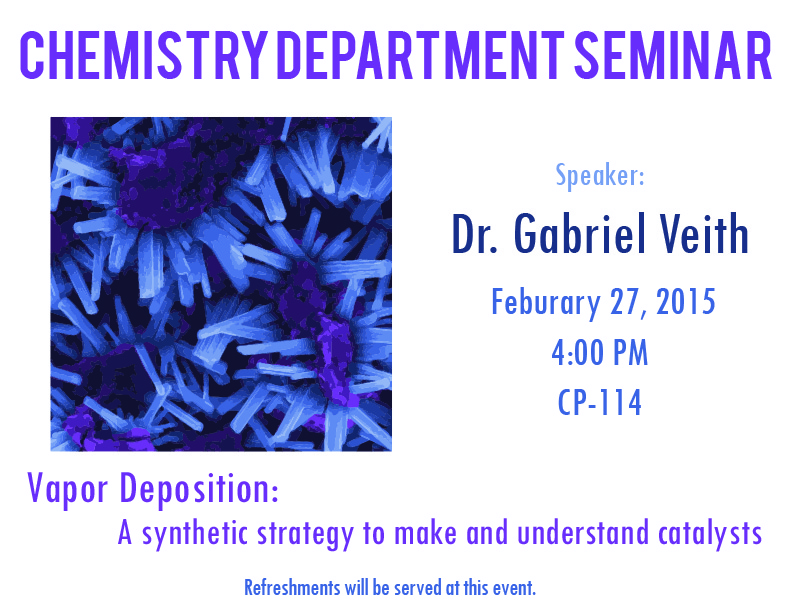
Dr. Gabriel Veith of Oak Ridge National Laboratory will be presenting a seminar titled Vapor deposition: A synthetic strategy to make and understand catalysts.
Abstract: This seminar will describe the use of physical vapor deposition methods to grow supported metal nanoparticles. While not a classical chemical synthesis method it introduces a new tool to the chemists arsenal. For example, this method enables us to understand the processes that go into making catalysts by the traditional decomposition of solution impregnated precursors on a metal oxide support. It also enables us to prepare new metastable materials such as PdN6 and PtN5. These materials have utility in the activation of N2 which currently accounts for about 3% of the world's energy consumption and is important to sustain the human population.
Faculty Host: Dr. Susan Odom
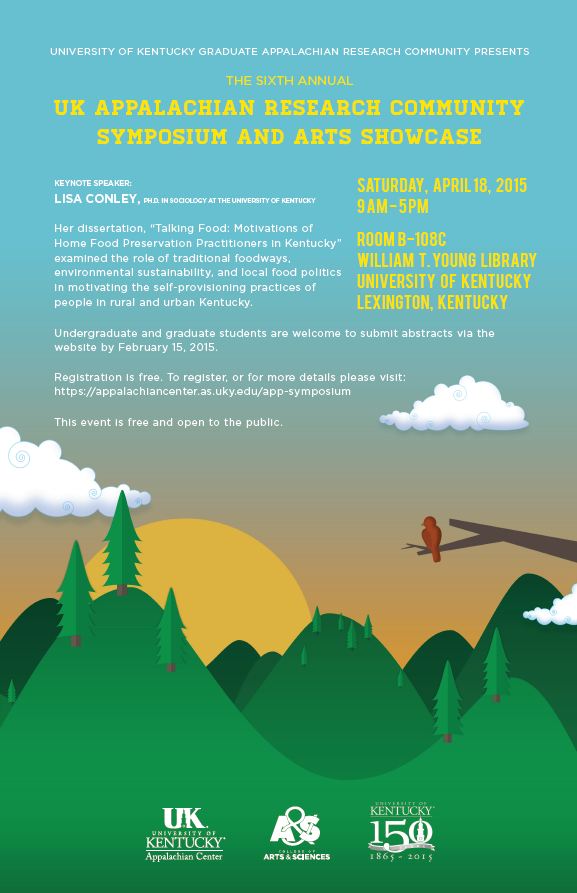
This is the 6th Annual GARC Symposium and Art Showcase. Graduates students with research and/or artistic interests in Appalachia are encouraged to submit proposals via the website. This is an opportunity for students to present their work on Saturday, April 18, 2015 at the W. T. Young Library, Room B108-C on UK's Campus. This event is planned by members of GARC (Graduate Appalachian Research Community), with support from the UK Appalachian Center. The times listed above are tentative for the event, and this page will be updated continually. Please, see the GARC page on this website for more information, the Call for Participation, and to submit your proposal: https://appalachiancenter.as.uky.edu/graduate-appalachian-research-community. The deadline for porposals is February 15, 2015.
Samuel R. Friedman, PhD, is Director of the Institute for Infectious Disease Research at National Development and Research Institutes, Inc. and the Director of the Interdisciplinary Theoretical Synthesis Core in the Center for Drug Use and HIV Research. Dr. Friedman is an author of about 450 publications on HIV, STI, and drug use epidemiology and prevention, including pieces in Nature, Science, Scientific American, the New England Journal of Medicine, JAMA, the American Journal of Epidemiology, and the American Journal of Public Health. Recent research projects have included a study of social factors, social networks and HIV, STI and other blood-borne viruses among youth and drug injectors in a high-risk community; a study of socioeconomic and policy predictors of the extent of injection drug use, of HIV epidemics, and of HIV prevention efforts in US metropolitan areas; a longitudinal study of how the HIV epidemics and related programs among people who inject drugs, men who have sex with men, and heterosexuals in US metropolitan areas are associated with each other; and the development of novel measures to understand how structural interventions or Big Events/Complex Emergencies affect variables related to HIV risk networks and behaviors. Honors include the International Rolleston Award of the International Harm Reduction Association (2009), the first Sociology AIDS Network Award for Career Contributions to the Sociology of HIV/AIDS (2007), a Lifetime Contribution Award, Association of Black Sociologists (2005), and a NIDA Avant Garde Award for research on Preventing HIV Transmission by Recently-Infected Drug Users.
Six University of Kentucky educators were recently named recipients of the UK Alumni Association 2015 Great Teacher Award.